Delivery formats
1
Public bootcamps run over 2-5 days and are organized around 2-4 real-world cases. Self-paced modules include guided notebooks, replayable pipelines and example manifests. Corporate workshops are tailored: we replicate a short project from your environment and convert it into a training scenario, enabling immediate transfer of skills.
Each delivery emphasizes reproducible artifacts: data snapshots, pipeline definitions, containerized model images and monitoring dashboards. Trainers walk teams through common failure scenarios and remediation steps so participants leave with both knowledge and working examples.
Pricing and licensing
2
Pricing depends on format and degree of customization. Standard public bootcamps have set per-seat fees, while corporate workshops are quoted based on scope: number of scenarios adapted, instructor days, and follow-up support. Licenses for course materials are provided per participant with an option for extended team access.
- Per-seat pricing for public workshops
- Custom workshop quotes based on scope
- Extended access licenses for teams
For corporate engagements we provide a clear scope document listing adapted cases, expected deliverables, environment needs and success criteria measured by hands-on assessments and deployable artifacts.
Custom case workshops
3
Custom case workshops begin with a scoping session where we identify a representative project. We then build a condensed scenario that preserves key technical challenges — data quality issues, streaming vs batch requirements, model validation constraints — and run the workshop with your team to produce a working pipeline and deployment plan.
Example: a retail chain workshop where teams produced a weekly ETL DAG, a feature store design and a deployable sales-forecast model within three workshop days.
Follow-up includes an artifact handover and a short remediation plan listing next steps for production hardening, observability additions and incremental governance tasks.
Assessment and outcomes
4
Assessments focus on applied skills: participants complete mini-sprints against scenario checkpoints (data ingestion, transformation, test coverage, model validation and deployment). Results are documented as a rubric and a set of deliverables that teams can iterate on in their own environments.
In our Data and AI workflow courses we emphasize applied scenarios drawn from management, manufacturing and healthcare. Each module presents a real-world case, followed by a guided walk-through: problem framing, data collection checklist, pipeline design, model evaluation and deployment considerations. Learners work with sample datasets and reproducible notebooks that mirror production constraints in Swiss organizations.
Practical scenarios, not only theory
Modules conclude with a compact retrospective: what engineering activity-offs were made, how monitoring was set up, and a checklist for handover to ops teams. This case-driven approach helps teams adopt repeatable patterns for data ingestion, feature pipelines and model lifecycle management.
Partnerships
5
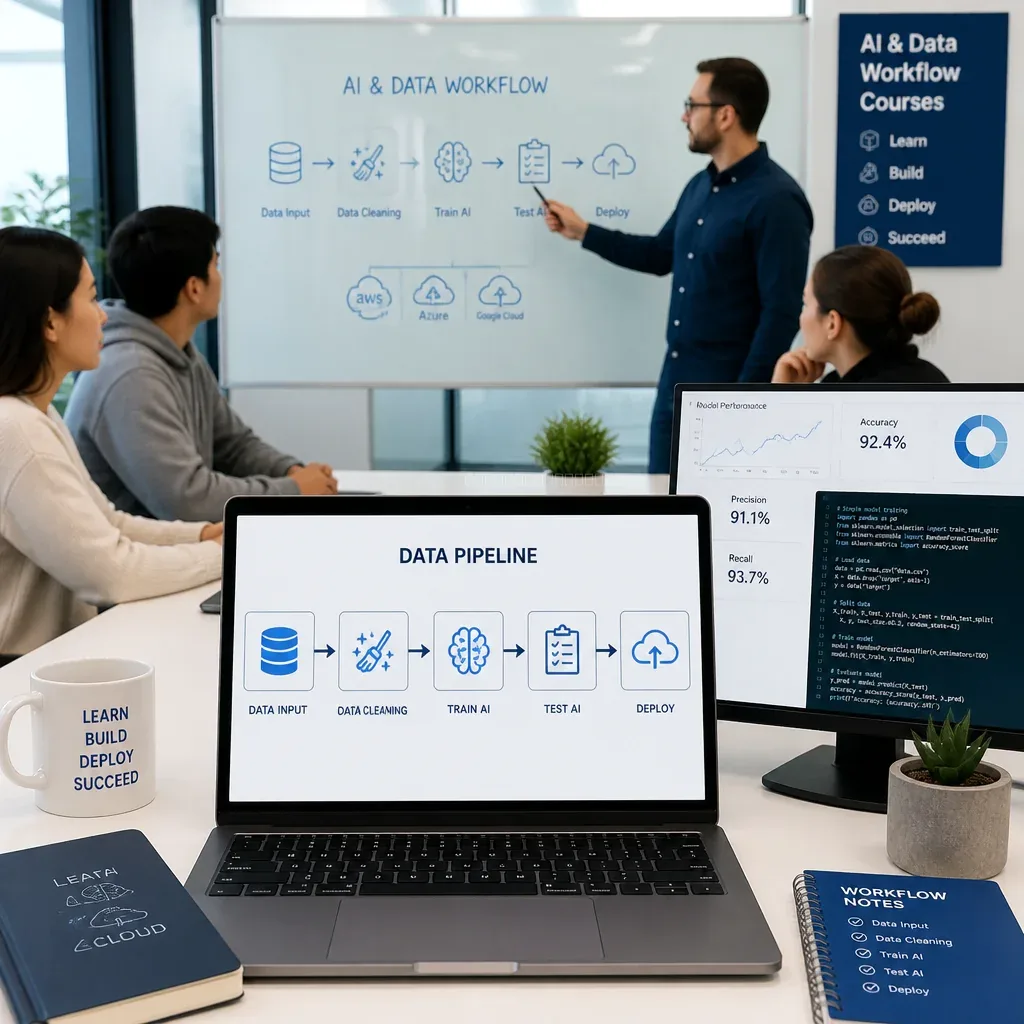
We structure training around end-to-end workflows: data acquisition, cleaning, feature engineering, model selection, validation, deployment and monitoring. Each topic is anchored to a case study that participants implement step by step.
Participants receive templates for production-ready pipelines, example CI/CD scripts for models and pragmatic playbooks for versioning data and models in cross-functional teams.
Infrastructure and tools
6
Typical course outcomes focus on skills and artifacts rather than lofty promises. By course end, teams will have implemented a minimally viable workflow for one use case and a clear plan to extend it to other problems.
- Case study: customer churn prediction — from raw logs to a deployed endpoint with monitoring hooks.
- Case study: predictive maintenance — sensor data ingestion, feature pipelines and alerting scenarios.
- Case study: document intelligence — OCR pipeline, entity extraction and data validation in a compliance setting.
Each case includes starter code, test data and a checklist for operational readiness. Trainers highlight common pitfalls and provide mitigation strategies tested in enterprise environments.
Support and follow-up
7
We recommend a blended format: short lectures, hands-on labs and post-course office hours. This structure allows participants to apply learnings immediately to their business context with mentoring support.
Follow-up consulting options are available to help teams adapt the workflow artifacts produced in class to their infrastructure and governance requirements.